DISTANT BODIES & ACCOMPLICES
On Remote Reality Games, a practice based research by Carina Erdmann (2019 - ongoing)
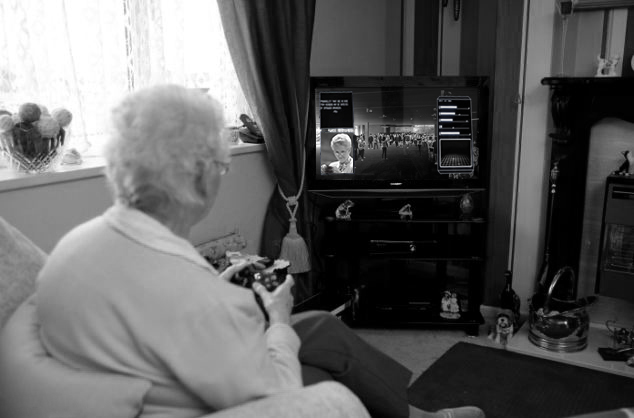
Remote Player, photoshop sketch (2019)
Remote Reality Games (RRGs) are hybrids between online gaming and Live Action Role Play (LARP) developped to critically reflect on the social, emotional, and psychological implications, as digital technologies increasingly mediate our lives.
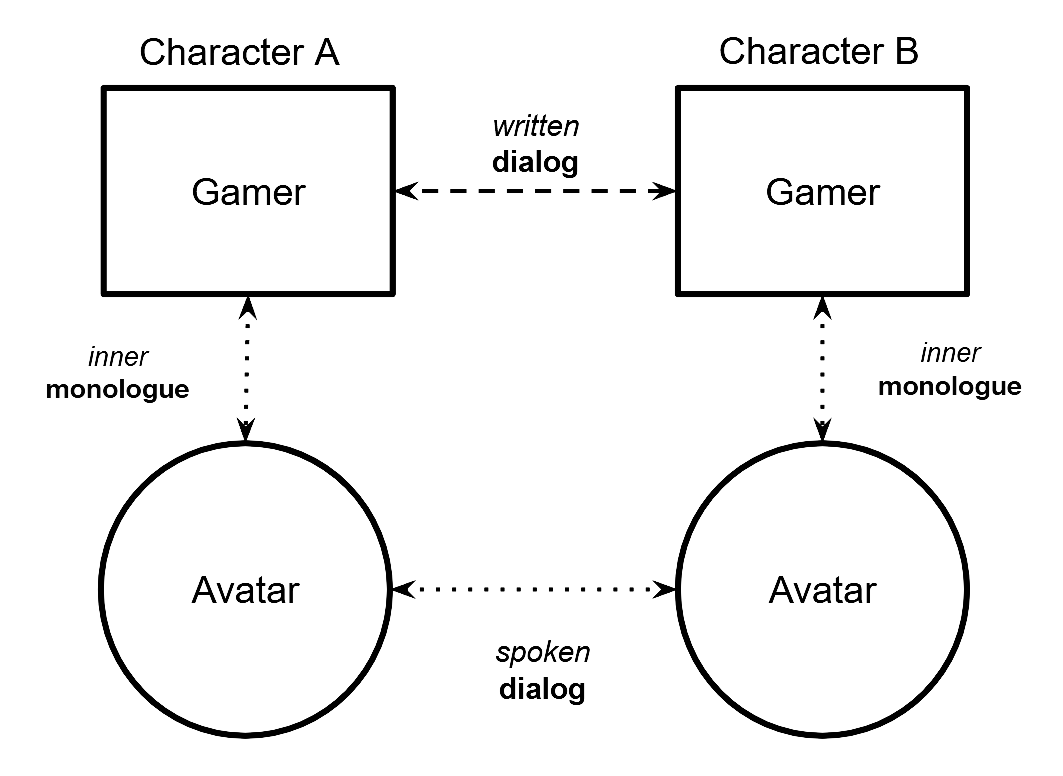
RRGs use the framing of a video game, in which the gamer controls the avatar. Yet both roles are embodied by real players with the ability to negotiate the dynamic between gamer and avatar, their shared and individual agency. The avatar’s physical environment is leveraged as game space, captured via livestream, while the gamer provides verbal instructions, merging in a shared experience through guided dialogue, improvisation and collaborative storytelling. The real-world environment is overlaid with a speculative co-narration, where commentary, annotation, and the emergence of paratextual elements shape player experience and interpretation. Somatic scores prompt avatars to tune into particular modes of perceiving either by tapping into bodily sensations or the virtual reality of imagination. Experience and perception meld into a navigational approach to narrative.
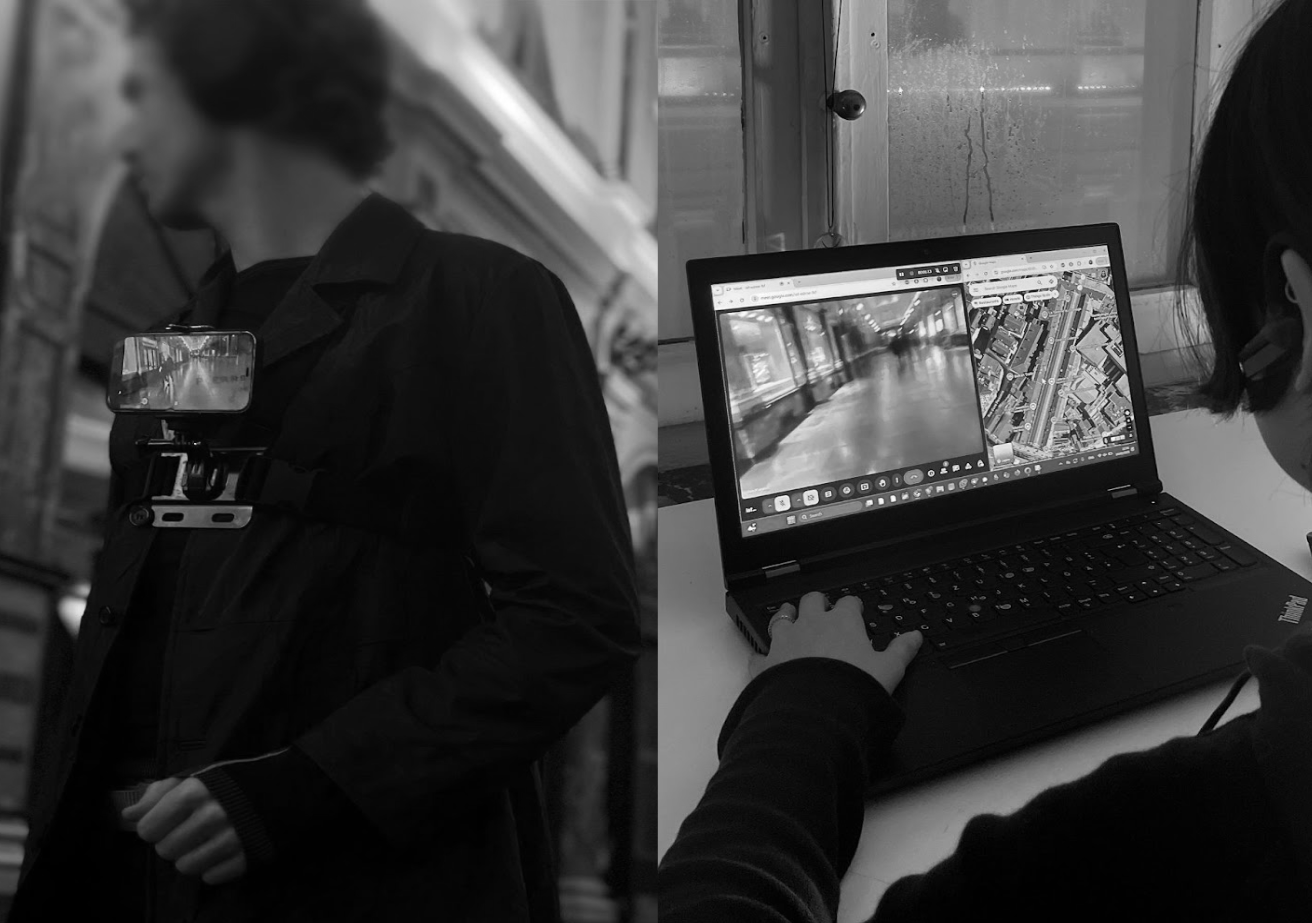 “Temporal Worlding”, RRG, 2024, Avatar: Jan Kunkel, Gamer: Steph Holl-Trieu
RRGs do not require a designed digital world or interface. Instead, they appropriate exisiting communication platforms to “install” their parasitic software: Verbal or written scripts or scores (as they are called in Fluxus art or performance improvisation) guide an altered perception or speculative subversion of the given world. The playful engagement with technological infrastructures seeks for a critical and practical understanding of how these systems already shape our behavior, particularly as many are already structured as games, with social media platforms frequently likened to slot machines.
In times of Proxy wars and drone-enabled remote killing with interfaces that are not unsimilar to gaming interfaces, it becomes necessary to assess how distance contributes to behavior and how the real in the virtual, the violence but also the sensuality, can be mediated and assessed.
The games we play are ideological. They provide rehearsals for life within a given social, political, or economic structure. Can game design become a tool to understand and hack the games at play?
WORKSHOPS:
PORTALS - Play with distance
Lecture and Workshop on Remote Role Play at iWeek2021, LAB University of Applied Sciences, Online
How can the surrounding environment be incorporated in worldbuilding? What are rules that enable meaningful dialogue? How to integrate movement into screen interactions? How can distant places share one physical game space?
Carina Erdmann
Where the unborn conspire
Worlding workshop for more than one voice with School of Commons at Shedhalle Protozone 4 + online, 18.09.21
The workshop approaches worlding through voice, breath, relational dynamics, and role-play techniques. Participants play a character from the computer at home or become their body moving through the theater space. They act as accomplices that construct the metaphysics of another world after ‘The end of the World’
Carina Erdmann & Lendl Barcelos
Temporal Worlding
Remote Reality Games as Spatio-Temporal Navigation and Narration, Hybrid w orkshop at DIGRA conference in Guadalajara and online ,1-5th July, 2024
Participants are paired as one player that directs the other as avatar walking through the city via voice call. The game play is facilitated through a narrative that overlays the real world environment of the players with a speculative framing using temporal navigation systems and narrative structures from games.
Carina Erdmann & Steph Holl-Trieu
Distant Bodies & Different Worlds
Worlding Workshop at RITCS School of Arts, Dept. of Animation, Brussels (upcoming in winter 2024)
Participants develop a critical understanding of the relationship between people and their digital proxies and learn to generate and reflect on the narrative frameworks and game mechanics that enable different forms of agency in interaction through and with screens.
Carina Erdmann, Karin Verelst, Sébastien Hendrickx, David Tann & Ash Eliza Smith
GAME PROTOTYPES:
LUCIID
Hybrid game that combines methodologies from Role Play and Computer Game Design, Therapy and Performance Improvisation set in a state of connected Hypnagogia.
Buried Accomplices
Online LARP that lets you reflect on your present through the lens of historic imaginaries of the future as well as speculative future visions onto the past.